The Ultimate Guide to Crafting the Best 3-Ingredient Homemade Gluten-Free All-Purpose Flour Blend
Discover how to easily create the most economical and versatile gluten-free flour blend right in your own kitchen! This exceptional three-ingredient recipe allows you to prepare large batches, serving as a reliable all-purpose flour that excels in a wide variety of baked goods. Experience flawless results every time, as this blend acts as a perfect 1:1 substitute for traditional wheat flour, ensuring your gluten-free creations are indistinguishable from their conventional counterparts.
This post contains affiliate links, meaning if you click and make a purchase, I may receive a small commission at no extra cost to you.
Why This Homemade Gluten-Free Flour Blend Will Revolutionize Your Baking
As the holiday season approaches and baking becomes a cherished activity, having a dependable, allergy-friendly, and all-purpose gluten-free flour blend is absolutely essential. This recipe is designed to carry you through the busiest baking periods, making your culinary adventures stress-free and delicious.
The world of gluten-free baking has often been misunderstood. Many people recall early attempts at gluten-free goods a decade ago, leading to disappointing experiences with dense, dry, or crumbly results. Consequently, a misconception arose that all gluten-free baked goods are inferior. However, just as conventional wheat baking required a learning curve that most of us weren’t present for, gluten-free baking has evolved dramatically. Today, with the right ingredients and techniques, it has reached new heights of quality and deliciousness.
After more than six years of dedicated use, I can confidently say this homemade gluten-free flour blend is a game-changer. It consistently delivers exceptional performance across all types of baked goods, from chewy bars and fudgy brownies to soft cookies and tender cakes. The results are always moist, never gritty, and remarkably, this blend can be substituted cup-for-cup for regular wheat flour in almost any recipe. This means if a recipe calls for 1 cup of wheat flour, you simply use 1 cup of this homemade blend.
Perhaps the most compelling testament to its quality comes from those who don’t follow a gluten-free diet. I frequently serve my baked creations to friends and family, and their amazed reactions—”THAT’S gluten-free??”—speak volumes. This blend truly passes the taste test, proving that gluten-free doesn’t have to mean flavor-free or texture-compromised.
The Undeniable Advantages of Crafting Your Own Gluten-Free Flour Mix
Opting to create your own gluten-free flour blend offers numerous benefits, starting with significant cost savings. It can be disheartening to realize that replacing wheat flour often requires purchasing multiple specialized flours. However, this is the reality for achieving that coveted texture and performance in gluten-free baking. My goal with this recipe is to make that process as affordable as possible, utilizing only three core ingredients. You’ll notice some gluten-free flour recipes call for four to six ingredients, which can quickly become cost-prohibitive and overly complex.
Another major advantage is the ability to prepare large quantities. There’s nothing more frustrating than having a sudden baking craving, only to realize you need to mix up a new batch of flour. By making your own in bulk, you ensure a ready supply, making spontaneous baking sessions a joy rather than a chore. I recommend storing your freshly mixed flour in airtight glass jars, as shown in the images, to maintain optimal freshness and extend its shelf life.
The growing popularity of gluten-free diets has led to an explosion of alternative flour options: sorghum, buckwheat, millet, chickpea, coconut, fava bean, and many more. While this variety is wonderful, many of these specialty flours are often harder to find in conventional grocery stores and come with a higher price tag. This recipe focuses on readily available and more affordable staples without compromising on quality or performance.

Brown Rice Flour vs. White Rice Flour: Can You Substitute?
A common question in gluten-free baking is whether brown rice flour can be used interchangeably with white rice flour in blends. In my experience, both brown rice flour and white rice flour are quite flexible and can be substituted for one another in this blend. I typically opt for white rice flour because it tends to be more budget-friendly, often possesses a slightly “softer” texture, and is generally easier to locate in most grocery stores. While brown rice flour offers a nuttier flavor and slightly higher fiber content, white rice flour provides a more neutral taste and finer crumb, which many bakers prefer for all-purpose uses. Feel free to choose based on availability, preference, and desired nutritional profile.
Is Making Your Own Gluten-Free Flour Blend Truly More Economical?
Determining the exact cost savings of homemade gluten-free flour can be complex, as prices for individual ingredients fluctuate significantly based on geographic location, brand choice, and whether you purchase in bulk. The spectrum ranges from highly economical bulk ingredients to premium organic options. Furthermore, the comparison depends heavily on which commercial gluten-free flour blend you’re measuring it against—from value brands like Walmart’s Great Value to high-end specialty brands such as King Arthur.
To provide a clear comparison, let’s consider purchasing all components from a widely available brand like Bob’s Red Mill. For my blend, which yields approximately 6 cups, here are typical local prices and weights:
- 24 oz/680 g Bob’s Red Mill White Rice Flour: ~$4.49
- 22 oz/623 g Bob’s Red Mill Potato Starch: ~$5.99
- 16 oz/454 g Bob’s Red Mill Tapioca Flour/Starch: ~$4.49
TOTAL INITIAL COST: ~$14.97
In contrast, a comparable commercial all-purpose gluten-free blend might cost around $6.98 but typically yields only about 5 and 1/4 cups. At first glance, the pre-made blend might appear cheaper. However, a crucial factor is that your initial purchase of individual flours will leave you with substantial amounts of potato starch and tapioca flour leftover. This means subsequent batches of your homemade blend will require significantly less additional expenditure, quickly bringing down the per-batch cost and making it more economical in the long run, especially if you bake frequently.
For even greater savings, I often source my gluten-free flour components from local stores like Winco, which offer bulk bins where ingredients can be purchased by the pound. Online retailers like Thrive Market also provide discounts on specialty foods, making them excellent resources for bulk purchases. This approach further solidifies the economic benefits of making your own blend.
Beyond cost, many bakers prefer homemade blends due to specific dietary needs or preferences. Commercial all-purpose blends frequently contain xanthan gum, which some individuals cannot tolerate. Additionally, pre-made mixes often include a long list of additives such such as vitamins, minerals, cellulose, psyllium husk, or other grains like sorghum, oats, or millet, which may not be suitable for everyone. The simplicity of my three-ingredient blend offers unparalleled control and peace of mind for those managing multiple allergies or sensitivities, making the slightly higher initial cost well worth the investment in health and customization.
Furthermore, keeping single-grain flours on hand is incredibly beneficial. Many gluten-free recipes, especially more specialized ones, might call for a specific single grain rather than a blend. For example, my popular gluten-free tortilla recipe requires extra tapioca flour, something you’d already have if you make your own blend. Ultimately, the decision rests on balancing your budget with your health needs. If creating your own gluten-free flour blend is a goal, this recipe provides an accessible and effective path to achieving it.
Demystifying Gluten-Free Flour Substitution: What You Need to Know
When a recipe calls for flour, it serves as a fundamental structural component, providing bulk, texture, and binding properties. Therefore, it is crucial to understand that you cannot simply omit it or substitute it with a non-flour ingredient. If a recipe requires a grain, it absolutely needs a grain. More importantly, you cannot replace regular wheat flour with a single gluten-free grain flour. For instance, attempting to use only brown rice flour in a recipe designed for wheat flour will almost certainly lead to disappointing results. Wheat flour possesses a unique combination of proteins and starches that provide elasticity and structure, properties that require a sophisticated blend of multiple gluten-free grains and starches to mimic effectively.
Fortunately, this particular homemade gluten-free flour blend is engineered to perform as a 1:1 substitute for regular wheat flour in many recipes. However, gluten-free baking often involves more than just a simple flour swap. The absence of gluten means changes in hydration, structure, and rise. Some recipes may require slight adjustments to liquid content, or the addition of a binding agent like xanthan gum, which helps replicate gluten’s elasticity. This is why I strongly advise against merely “tweaking” conventional recipes that were not specifically developed to be gluten-free. The science of gluten-free baking is nuanced; dedicated gluten-free recipes have been meticulously tested and refined to account for these differences. By using a tried-and-true gluten-free recipe, you benefit from the time, effort, and expense someone else has already invested in perfecting it, saving you potential frustration and wasted ingredients.
For more complex baked goods, such as yeast breads, specific gluten-free bread flours are often necessary. These blends typically feature a more robust ingredient list and are formulated with the unique structural demands of bread making in mind. While my blend is ideal for cookies, muffins, cakes, and cupcakes, for specialized items like breads, you might find commercial options such as Better Batter, King Arthur’s Measure for Measure, or Bob’s Red Mill 1:1 Baking Flour to be better suited for a direct substitution in bread recipes, providing a solid foundation for your creations.
The Critical Role of Finely Ground Gluten-Free Flours in Baking
The quality of your gluten-free baked goods hinges significantly on the fineness of the grind of your flour components. If you choose flours from manufacturers that do not mill their ingredients to a very fine consistency, your final product can end up with an undesirable grainy texture. This unpleasant mouthfeel is particularly noticeable because many gluten-free flours, including rice flour – a primary base for most blends – originate from hard grains. Imagine the inherent hardness of raw rice kernels; if these aren’t meticulously milled and ground into an ultra-fine powder, their presence will be distinctly felt in the finished baked good, detracting from the overall experience.
As you gain more experience in gluten-free baking, you will naturally develop a preference for certain brands that consistently deliver superior results and a smooth finish. It’s important to remember that the journey of learning to bake gluten-free is a process marked by both successes and occasional setbacks. Embracing these ups and downs as part of the learning curve is perfectly normal and healthy. The triumphs—those perfectly textured, delicious new recipes—will feel all the more rewarding precisely because of the effort and experimentation that led to them. Always prioritize finely ground flours to ensure the smoothest, most delectable outcome.
Where to Source Your Homemade Gluten-Free Flour Ingredients
Finding high-quality ingredients is the first step to a successful homemade gluten-free flour blend. Here’s a list of common retailers where I often purchase the components for my recipe:
- Sprouts Farmers Market
- Whole Foods Market
- Walmart (check for specific brands and bulk options)
- Winco Foods (excellent for bulk purchases)
- Smiths Food & Drug
- Maceys
- Natural Grocers
- Amazon (convenient for online ordering and bulk options)
Expert Tips for Mixing Your Gluten-Free Flour Blend
Achieving a perfectly uniform blend is key to consistent baking results. Here’s my tried-and-true method for mixing your homemade gluten-free flour blend:
Start by accurately measuring all three ingredients – white or brown rice flour, potato starch, and tapioca starch – into a large mixing bowl. Once combined, take a whisk and thoroughly mix the flours. Whisking ensures an initial even distribution of each component. For an even more thorough integration, secure a lid tightly onto the bowl and shake vigorously for about 30 seconds to a minute. Before opening the lid, be sure to tap the bowl firmly on the counter a few times. This crucial step helps settle any airborne flour particles, preventing a sudden “flour cloud” from escaping when you open it. To maintain optimal consistency, especially if the blend has been sitting for a while, it’s always a good practice to give it another quick shake (with the lid on) before each use.
Mastering the Art of Measuring Gluten-Free Flour
Proper measurement is an absolutely critical, yet often overlooked, step in gluten-free baking, influencing the final texture and success of your recipes. This technique applies both when assembling your gluten-free flour blend and when measuring the blend for a specific recipe:
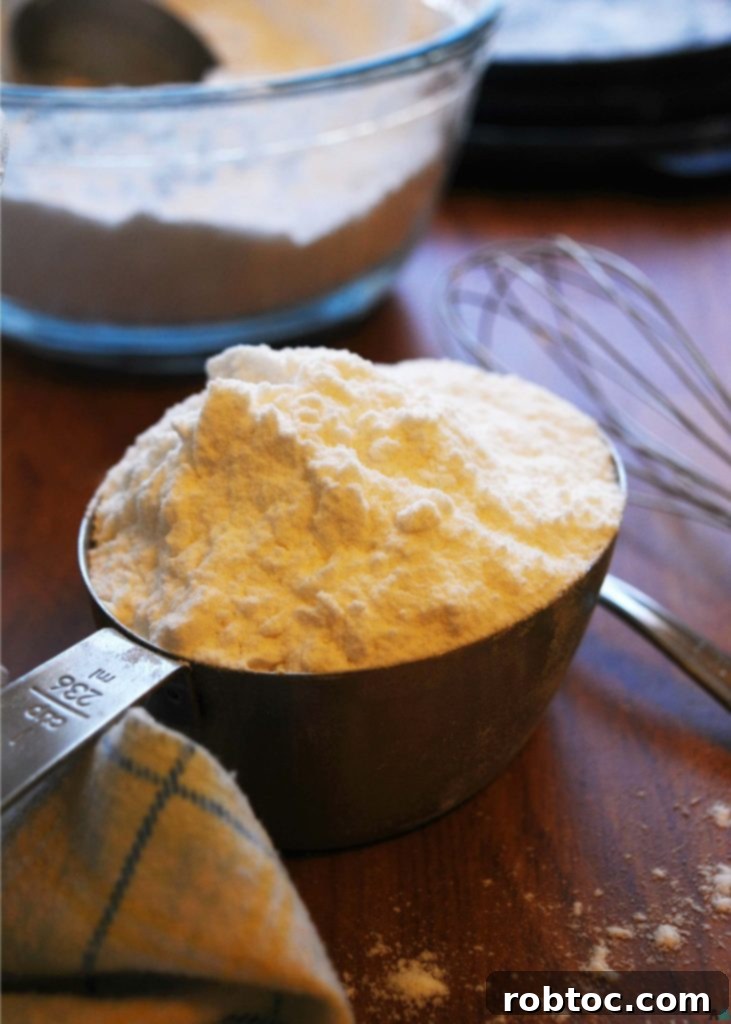
Always use a large spoon to gently scoop and “dump” the flour into your measuring cup until it overflows, forming a slight dome above the rim. Crucially, do NOT scoop the flour directly with the measuring cup or pack it down. Scooping can compact the flour, leading to an inaccurate, excessively dense measurement. Once the cup is overflowing, take the flat side of a knife or a straight edge and level off the excess flour, creating a clean, even line across the top of the measuring cup. This method ensures you achieve the correct flour-to-liquid ratio, which is vital for replicating that soft, light texture characteristic of wheat-based baked goods. Incorrect measurement is a common pitfall in gluten-free baking, so watching the video above for a visual demonstration of this technique can be incredibly helpful.
By following these precise mixing and measuring techniques, you’ll set yourself up for consistent success, allowing you to confidently enjoy your cherished classic recipes and embark on new baking adventures!
**PLEASE NOTE: Gluten-free flour, by its nature, lacks the gluten proteins that provide elasticity and structure for rise in regular flour. To compensate for this, almost all of my recipes include xanthan gum, a crucial ingredient that helps provide the necessary structure, rise, and airy texture typically found in wheat-based baked goods. I deliberately choose not to include xanthan gum directly in my all-purpose blend because the optimal amount varies significantly depending on the specific type of recipe (e.g., cookies versus cakes). This ensures that each recipe receives the precise amount needed for perfect results. As a general guideline, when adapting a recipe to be gluten-free using this blend, a good rule of thumb is to add one teaspoon of xanthan gum per one cup of gluten-free flour.**
The Simple Foundation: What Makes Up This Gluten-Free Flour Recipe?
The brilliance of this recipe lies in its elegant simplicity and efficiency, relying on just three core ingredients to achieve remarkable results. You’ll need:
- White rice flour or brown rice flour: While brown rice flour can be used, I personally favor white rice flour for its lighter texture and more neutral flavor profile in baked goods.
- Potato starch: This is crucial! Ensure you are using potato starch, NOT potato flour, as they have vastly different properties and cannot be substituted for one another.
- Tapioca flour/starch: Also commonly referred to as tapioca starch, this ingredient adds a delightful chewiness and helps with browning.
Potato Starch vs. Potato Flour: Understanding the Difference
It’s a common point of confusion, but to be clear: potato starch and potato flour are distinctly different ingredients. Potato starch is extracted from potatoes through a process that removes the protein and fat, leaving behind pure starch. It’s a fine, white powder that acts as a thickening agent and provides a light, airy texture in baking. Potato flour, on the other hand, is made from whole, dried potatoes that have been ground into a powder. It contains protein, fiber, and flavor from the entire potato, making it much heavier and absorbent. They are not interchangeable in recipes, especially in gluten-free baking where precise ratios are critical for texture.
Tapioca Flour vs. Tapioca Starch: Are They the Same?
Unlike potato starch and potato flour, tapioca flour and tapioca starch are indeed the same product and are commonly used interchangeably. Both terms refer to the finely ground starch extracted from the cassava root. It’s a versatile ingredient that contributes to a crisp crust, chewy texture, and helps bind gluten-free baked goods. So, whether your recipe or ingredient label says “tapioca flour” or “tapioca starch,” rest assured you’re working with the same ingredient.
Identifying What NOT to Bake with This Gluten-Free Flour Blend
While this versatile DIY gluten-free flour blend is a powerhouse for many baking applications, excelling in recipes like light and fluffy pancakes, moist muffins, rich brownies, chewy bars, delicate cakes, and crisp cookies, it’s important to recognize its limitations. For items that require a more robust structure and significant yeast-based rising, such as traditional breads, specialized ingredients and specific formulations are often necessary. Attempting to simply substitute this blend into complex bread recipes may not yield the desired results. Instead, it’s best to seek out and follow dedicated gluten-free bread recipes that have been specifically developed and tested for these more intricate baked goods. For instance, my highly acclaimed gluten-free dairy-free homemade bread recipe relies on a particular boxed mix for its unique structure, and my gluten-free vegan breadsticks recipe also calls for a specific store-bought blend designed for bread-like textures. Using the right tool for the job ensures success and satisfaction in all your gluten-free baking endeavors.

Delightful Creations: What You CAN Bake with This Gluten-Free Flour
This fantastic all-purpose gluten-free flour blend unlocks a world of delicious baking possibilities! It’s perfectly suited for a wide array of treats, consistently delivering excellent results. Here are some of our most beloved and highly-rated gluten-free recipes that shine with this homemade blend:
- The BEST Gluten-Free Vegan Brownies: Achieve fudgy, rich, and utterly irresistible brownies every time.
- Allergy-Friendly Chocolate Cupcakes: Light, moist, and perfect for any celebration, free from common allergens.
- Gluten-Free Vegan Chocolate Sheet Cake: A crowd-pleasing, easy-to-make cake that’s wonderfully tender and chocolatey.
- Gluten-Free Baked Chocolate Donuts: Enjoy perfectly soft and sweet donuts, baked not fried, for a healthier treat.
- 20+ Allergy-Friendly Muffin Recipes: A collection of versatile muffin recipes that come out beautifully moist and flavorful.
- Gluten-Free Sugar Cookies: Create classic, crisp-on-the-edges, soft-in-the-middle sugar cookies that hold their shape perfectly.

The BEST Homemade Gluten-free Flour Mix
6 cups
10 minutes
10 minutes
One of the easiest (only three ingredients!) and cheapest gluten-free flour mixes you can make. Homemade so you can make large batches, this is a fabulous all-purpose flour you can use in any baked good. I substitute it 1:1 for regular wheat flour and it turns out beautifully.
Ingredients
- 4 cups rice flour (you can use brown or white rice)
- 1 and 1/3 cups potato starch (NOT flour)
- 2/3 cups tapioca starch (also known as tapioca flour)
Instructions
- Taking a large spoon, gently pour the ingredients into the specified measuring cups. Pour more than needed, making a domed measuring cup. Take the back of a knife, and scrape the excess off, leaving a clean, even line with the measuring cup.
- Measure each ingredient and pour into a large bowl.
- Whisk the ingredients to evenly distribute.
- Afterwards, put a lid on the bowl and shake to finish distributing it well.
- Tap the bowl on the counter before opening it, to ensure it has settled and you don’t get a cloud of flour when you open it.
- This can keep in your fridge for several months, if air-tight (although mine never lasts that long!)
- If your flour has sat for a while, you’ll want to re-whisk it to make sure the ingredients have not settled too much before using it in a recipe.
- Once this recipe is made, it can be swapped 1:1 with regular flour–keeping in mind you’ll still need a leavening agent like xanthan gum (which all of my recipes include).

This exceptional gluten-free flour blend recipe is a fantastic adaptation from the celebrated baking genius, Cybele Pascal, and her invaluable cookbook, “The Allergen-Free Baker’s Handbook“, a must-have resource for anyone navigating allergy-friendly baking.
Don’t forget to pin this recipe to your favorite boards so you can easily find it for your next baking session! Also, be sure to explore my other allergy-friendly Pinterest boards for more inspiration and delicious recipes.
